Kp Index and the Northern Lights: Complete Guide
What is the Kp index? What Kp do you need to see the northern lights? And what does it really mean for aurora photography? The answers are simpler than you think — and more useful than many believe.
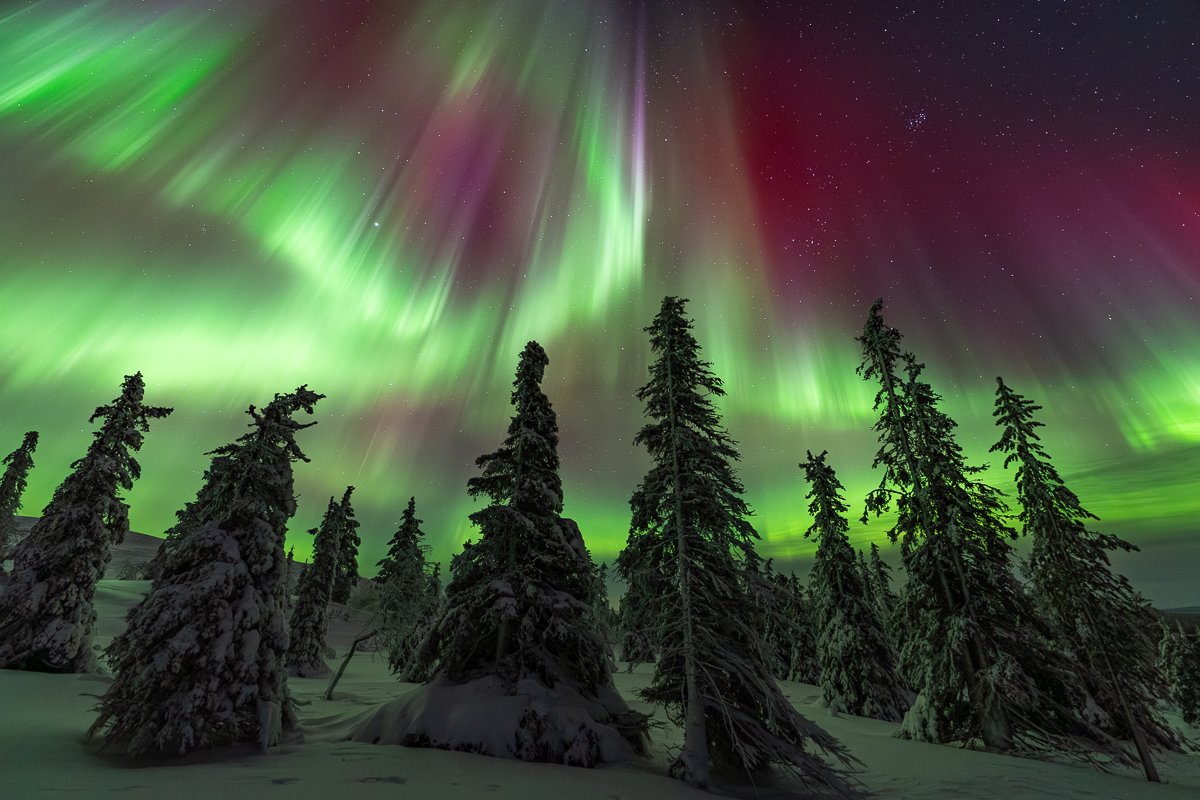
Kp4–Kp5 and aurora that you're hoping for
There are two opposite opinions about the Kp index among aurora photographers. Some treat it as the single most important aurora forecast number — and in a sense they're right, because Kp is the only forecast parameter we have for the medium and long term, beyond the next hour or so. Others say it's overrated and you shouldn't bother with it at all.
As usual, the truth is somewhere in the middle.
I've been in both camps. Early on, I wrongly assumed that the Kp forecast told me exactly when I could see the northern lights. I even checked the current Kp while standing in a field, waiting for the lights to appear. That was useless, and you'll see why. But I also understand the frustration that drives people to dismiss Kp entirely.
The goal of this article is to explain what the Kp index actually is, what it can tell you, and what it can't — so you can use it as the useful tool it is, without being misled by it.
What is the Kp index?
In simple words, Kp is a parameter that shows the strength of geomagnetic activity — the activity that causes the aurora.
The sun constantly emits a stream of charged particles known as solar wind. When it reaches Earth, it interacts with our planet's magnetic field and causes disturbances in it. The Kp index measures those disturbances on a scale from 0 to 9, where 0 represents minimal activity and 9 represents the most extreme.
You may have come across the G-scale in headlines — G1 storm, G2 storm, and so on. This maps directly to Kp: Kp5 is a G1 geomagnetic storm, Kp6 is G2, Kp7 is G3, Kp8 is G4, and Kp9 is G5.
According to NOAA's Space Weather Prediction Center, the location and brightness of the aurora are directly correlated with Kp. This is what makes it such an important indicator for aurora photographers.
Here's the catch: what we see in apps and forecast tools is a predicted Kp — the actual Kp is only confirmed retroactively, after the event. This is the core reason even a promising forecast can result in a quiet night, and vice versa — which is why Kp should always be read as an indication of what may happen, not a guarantee.

Kp0–Kp1 and faint, quiet aurora that barely there
What Kp actually tells you as a photographer
Knowing the predicted Kp gives you a reasonable indication of what to expect across four key parameters — with the caveat above always in mind.
Visibility
Low Kp (0–2) means a faint aurora. At Kp0 and Kp1, you usually can't see anything with the naked eye — but your camera will capture the glow. From Kp3 upward the aurora becomes clearly visible. At Kp5 and above it can be bright enough to illuminate the landscape, and even a full moon won't prevent you from getting a good shot.
Location and position in the sky
The aurora occurs within an oval-shaped zone around the poles. As Kp rises, this oval expands toward the equator, which means that the higher the Kp the further south northern lights can be seen. Kp also influences where in the sky the aurora appears at your specific location. Even in the polar regions, the aurora appears on the northern horizon when Kp is low. When Kp rises it goes higher in the sky above your head, stretching from north-east to north-west, or from east to west. During high activity, you can usually see aurora everywhere in the sky — but often the most impressive display happens even in the southern part of the sky. That's worth knowing before you set up your composition for the night.
Activity, shape, and color
When activity is low, the aurora typically appears as a quiet bow — a faint arc of light usually stretching above the northern horizon — that barely moves. In photographs its color is green, but the human eye can't detect the color of such dim light and it looks grey. This is how vision works in low light: your eyes switch to rod-based vision, which is sensitive to brightness but essentially color-blind. So you take a photo and check whether it's the aurora or a cloud.
As Kp rises and the aurora gets brighter, your eyes gradually start perceiving color. Over time, as you see the lights on the screen of your camera, you begin to recognise and then perceive green in the sky too. At high activity levels with fast-moving aurora, pink and purple become clearly visible with the naked eye. At Kp5 and above the aurora can be dancing all over the sky in green, purple, pink, and red — moving so fast you need a shutter speed of 1–2 seconds to freeze it.

Kp2–Kp3 and aurora that you'll most often encounter
Kp levels: what to expect
Kp0–Kp1: Faint, quiet, barely there
The aurora exists but is well below what most people imagine when they picture the northern lights. Invisible to the naked eye in terms of color — it looks grey or white if you see it at all. Your camera will reveal a soft green glow. These nights can work for calm, quiet compositions — especially with reflections — but they're generally not the northern lights you actually dream of.
Kp2–Kp3: What you'll most often encounter
This is your baseline on a typical trip. The aurora is visible with the naked eye, starts showing some movement, and occasionally surprises you. At Kp3 it's already a genuinely good level if you're in one of the classic regions — more active, more colorful, sometimes with a bright pink lower edge. Manage your expectations, but with the right landscape in front of you these nights can be beautiful.
Kp4–Kp5: What you're hoping for
This is where it gets exciting. The aurora is bright and active — like curtains moving in the wind, clearly green with purple and pink tints. At Kp5, classified as a G1 geomagnetic storm, the aurora becomes visible from almost all known aurora regions outside the classic ones — the Faroe Islands, the Canadian Rockies, Scotland, southern New Zealand, Tasmania, and more. If you're in a classic aurora region at this level with a clear sky, you have everything you need for an exceptional night.
Kp6–Kp9: Rare, remarkable, worth everything
These are events, not just nights. At Kp6–7 the aurora reaches places where it's a very rare phenomenon. Kp8 and Kp9 push into genuinely unusual territory. At this level the aurora often develops a striking red glow visible from much further south — a rare sight even for experienced photographers. During G4–G5 storms the aurora has been photographed from Italy, Florida, and Japan — more than 1,000 km from the classic aurora regions. When a forecast like this appears, treat it as the rare opportunity it is.
What Kp do you need at your location?
In all the classic aurora regions — Lapland, Iceland, northern Norway, northern Canada — any level of geomagnetic activity puts the aurora somewhere in the sky. The question is how bright it will be and in which part of the sky you should expect the main show. For locations further from the poles, the required Kp rises sharply as you can see from the table below.
To see the aurora directly overhead you need the auroral oval to expand all the way to your location. But even when the oval doesn't reach that far, you can still see the aurora on the northern horizon — because the aurora occurs very high in the sky at 100–300 km altitude, it remains visible from a significant distance. As aurora brightness rises with increasing Kp the further away it can be seen. During severe geomagnetic storms this can exceed 1,000 km — which is why during G4–G5 events people in Italy, Florida, and Japan have photographed the northern lights. As a general rule, you need a Kp two levels lower to see aurora on the horizon than overhead.
Kp for the aurora overhead / on the horizon
Tromsø, Norway Kp0/Kp0
Yellowknife, Canada Kp0/Kp0
Fairbanks, Alaska Kp1/Kp0
Abisko, Sweden Kp1/Kp0
Reykjavik, Iceland Kp2/Kp0
Rovaniemi, Finland Kp2/Kp0
Faroe Islands Kp4/Kp2
Canadian Rockies Kp5/Kp3
Northern Scotland Kp6/Kp4
Southern New Zealand Kp7/Kp5
Tasmania, Australia Kp7/Kp5
Kp index map
The map shows, for each Kp level, how far from the poles the aurora can be seen overhead and on the horizon.
Geomagnetic coordinates are determined using the model calculations provided by BGS Geomagnetism
For further planning, Step's Aurora Guide app automatically calculates the Kp index you need to see the aurora overhead and on the horizon for any location you choose.
How I actually use Kp now
I no longer expect Kp to tell me exactly what will happen in the sky. What it does is indicate what may happen — and that's genuinely useful, as long as you hold it as a possibility rather than a guarantee.
Before a trip I keep an eye on the 27-day forecast to get a sense of whether the period looks active and to adjust my plans accordingly. On the trip itself, the 3-day forecast becomes the one to watch. A promising Kp prediction is a signal to pay attention and prepare for a longer night. It also gives me a hint of where in the sky the aurora is likely to appear, which lets me think about compositions in advance.
My experience shows that following the forecast definitely increases your chances of making the right decisions. In March 2026, there were two days in a row with predicted high activity around Kp5–6, which implied the aurora might show up somewhere in the south. But my plan was to photograph the aurora above Vestrahorn mountain, which meant I needed it in the northern part of the sky. The forecast was correct and the aurora was dancing everywhere except exactly where I needed it. It was almost funny watching other photographers abandon their planned compositions and turn their cameras south.
That's the honest reality of Kp: it raises and lowers the probability of something interesting happening. If you understand what it actually is and what it can't promise, you'll find it useful rather than frustrating — and you won't be surprised when the sky decides to do something entirely different.
Where to find Kp forecasts
All Kp forecast data originates from the NOAA Space Weather Prediction Center. They publish a 27-day forecast every Monday and a 3-day forecast updated every three hours. Each serves a different purpose — I cover how to use both in Aurora Forecast: What You Must Know along with all the other forecasts you need for a successful aurora photography night.