The Best Time to See the Northern Lights
When is the best time to see the northern lights? What is each season actually like — for the aurora, the landscape, and the conditions? Here is everything you need to plan your trip.
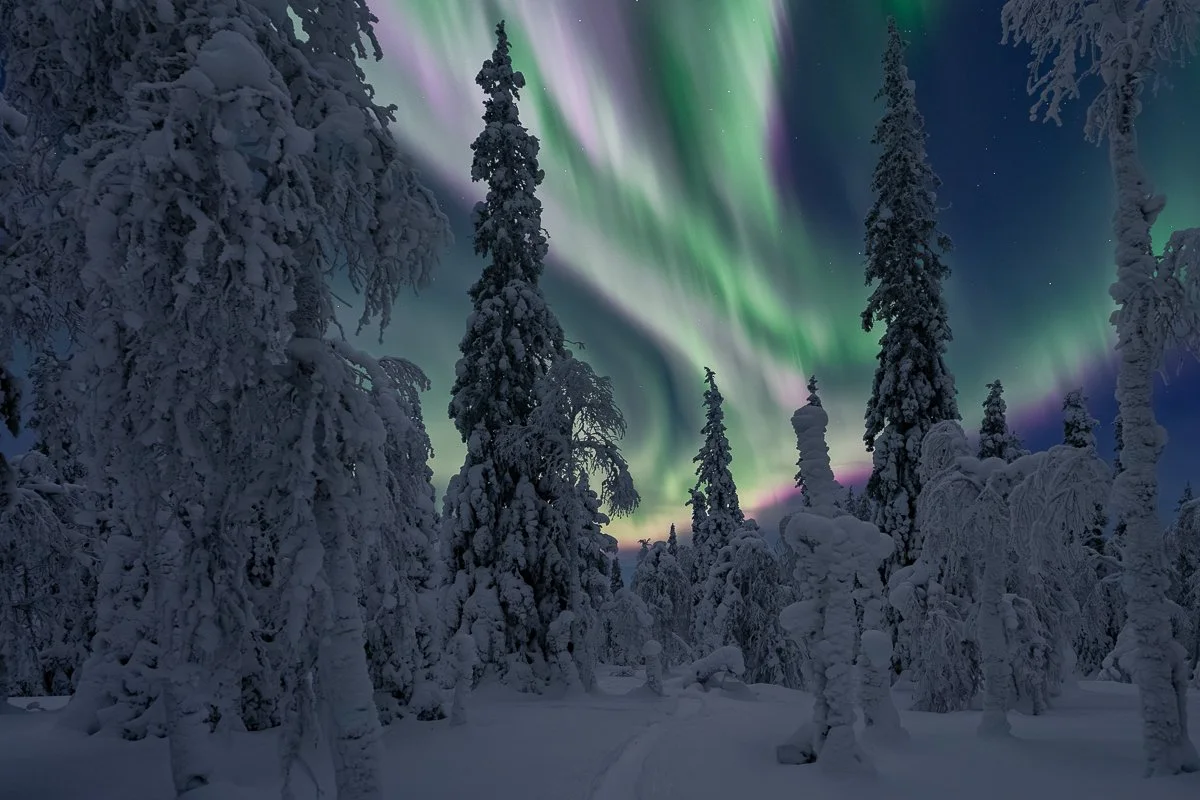
February, Finland. That night the forest fascinated me as much as the northern lights.
I fell in love with aurora photography in winter. The first time I captured the northern lights — on a January night in 2018, using my daughter's old camera and a stepladder for a tripod — I was completely enchanted. The dance of the lights, the silence, the stars, the snow-covered landscape in the moonlight. Winter felt like the only season that made sense for aurora photography.
Now, after years of exploring aurora destinations across different seasons, I find something worth photographing in each one. But they're not equal — and the right time for your trip depends on what you're looking for.
When can you see the northern lights?
Three things are necessary to see the aurora: geomagnetic activity, a clear sky, and darkness. Solar activity happens year-round. A clear sky can appear on any night. But darkness is seasonal — and in the classic aurora regions, that's the real question.
In popular aurora destinations across Scandinavia, Iceland, and northern Canada, there's a period called polar day that lasts from roughly April to August. During this time, even if the northern lights are active, it's simply too bright to see them. The aurora becomes visible when the sun dips around 10° below the horizon — that's when the sky darkens enough for the lights to show through.
When it gets dark enough
Canada, Churchill 17 July - 26 May
Canada, Whitehorse 27July - 16 May
Canada, Yellowknife 3 August - 9 May
Iceland, Reykjavik 9 August - 3 May
Alaska, Fairbanks 11 August - 1 May
Finland, Rovaniemi 18 August - 25 April
Finland, Levi 22 August - 21 April
Sweden, Kiruna 22 August - 21 April
Norway, Tromso 27 August - 16 April
One practical note: avoid the very first and last weeks of the season. During those periods the aurora may be visible only in the middle of the night and only faintly. Wait a week or two for the nights to become properly dark and the season to settle in.

September. Never stop being amazed by the variety of colours.
September — why it stands out
Twice a year, Earth's position relative to the sun creates conditions that produce more significant geomagnetic storms. This happens around the spring and autumn equinox — in March and September. More geomagnetic activity means more active, more frequent, and more dramatic aurora displays.
September combines this equinox advantage with some of the most beautiful landscapes of the year. In Lapland, northern Scandinavia, Canada, Alaska, and Iceland, the autumn colours are at their peak — birch trees turning gold and orange, open lakes still unfrozen and perfect for reflections, the landscape glowing with colour during the day and transforming into something magical under the aurora at night. The clear sky probability is also higher in early autumn than in the months that follow.
October–November — autumn into winter
This is a transition period, and nature creates something unique during these months. The landscape shifts from autumn into early winter — snow-covered fells and mountain tops, lakes and creeks still partly open with frost forming along the shores, shallow streams with snow-covered stones, unusual ice formations where open water meets the cold air. Later in November, thick hoarfrost starts to cover the trees. It's quiet, often just you and the landscape.
The trade-off is cloud cover. October and November tend to have more overcast days than September or the deep winter months — the clear sky probability drops and you may find yourself waiting longer for the right conditions. In November, short daylight hours also start to become a limitation for exploring new locations and scouting compositions during the day.
But for those willing to be patient and prepared, the rewards are images that look like no other time of year.
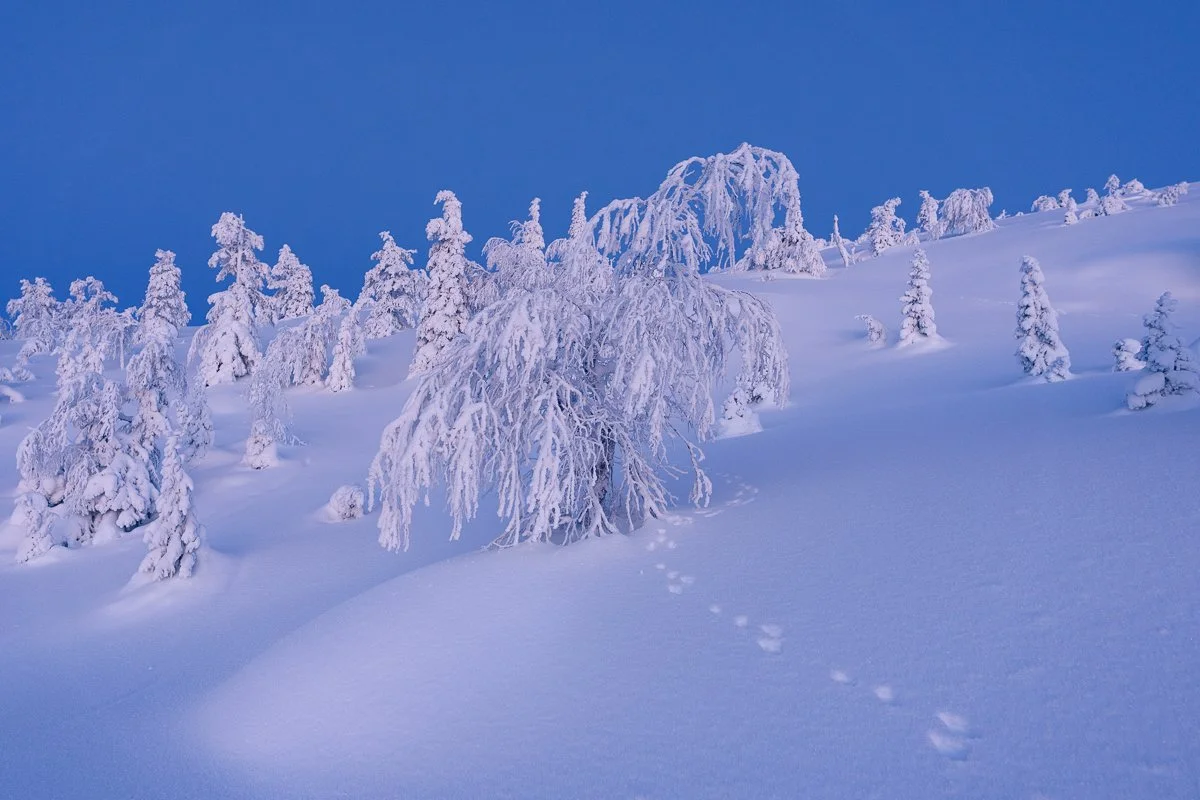
February. Fresh snow, a rabbit track, and no one else around.
December–February — deep winter
This is the season I fell in love with first, and I understand why it draws people. Snow-covered landscapes, frost-covered trees, moonlight sparkling on fresh snow, the crisp cold air and absolute silence. Winter nights in the north have a quality that's unlike anywhere else.
The aurora is active throughout these months and the nights are long — more dark hours means more opportunities. But there are real trade-offs to consider.
Daylight is extremely short, particularly in December and January. In the deepest part of winter above the Arctic Circle, you may have only a few hours of useful light for exploring and scouting. For someone visiting for the first time, this is a genuine limitation.
Weather and road conditions are also at their most challenging. Freezing temperatures, strong winds, and extreme driving conditions are real factors. For those unfamiliar with winter driving or without proper cold weather gear and clothing, these conditions can significantly affect your plans and your safety. This doesn't mean you shouldn't go — it means you need to be prepared and realistic about what winter in the far north actually involves.
March–April — spring equinox
March and April bring the second equinox advantage of the year — more geomagnetic activity, similar to September. The days are getting longer, which makes exploring and scouting locations much easier than in the depths of winter. Clear sky probability also improves compared to the October-February period.
The conditions are still genuinely winter in the north — snow, cold, wind, and challenging roads — though generally less extreme than December and February.
The trade-off is the landscape. By March, the magic of deep winter is fading. The beautiful hoarfrost that covers the trees in Finnish Lapland has mostly gone, melted by warmer days. Snow on the ground in Norway and Iceland can look patchy and tired rather than pristine. It's still worth going — the equinox effect and better sky conditions are real advantages — but manage your expectations about the landscape.
In April the season ends progressively from north to south. Check the darkness table above for your specific destination.
What about summer?
In the top aurora regions — Lapland, Iceland, northern Norway, northern Canada — it's simply too bright in summer to see the northern lights. The polar day makes it impossible regardless of how active the aurora is.
If summer is your only option, there are locations where it's dark enough year-round. Some lower-latitude locations in Canada — like Banff and Jasper National Parks — can offer aurora sightings even in summer. You can also consider southern New Zealand and Tasmania, where winter falls during the northern hemisphere summer.
Stay connected for your own trip
Every season offers something different — and the best time for you depends on what you want to see and experience. If you'd like to follow along as I explore new locations and share what I find in each season, subscribe below. You'll receive field notes from my trips and location updates to help you plan your own.